Gladsome Light Dialogues – An Orthodox Blog

A journey through our Orthodox faith as we live it every day

Gladsome Light Dialogues – An Orthodox Blog header image 2

A case of mistaken identity

September 1st, 2010 by Fr. Vasile
Respond

When I was still living in Romania I was going for confession to a hieromonk in a monastery not very far from my hometown. One day I took Maria, my daughter, with me. We participated in the services, got a blessing from the elder and on our way home she asked me, after being very silent and observant all the way: Dad was that man Jesus?

A similar confusion  happened to St. John the Baptist when the people of Israel confused him with Messiah: “this is the record of John, when the Jews sent priests and Levites from Jerusalem to ask him, Who art thou? And he confessed, and denied not; but confessed, I am not the Christ. And they asked him, What then? Art thou Elias? And he saith, I am not. Art thou that prophet? And he answered, No.” (John 1:19-21)

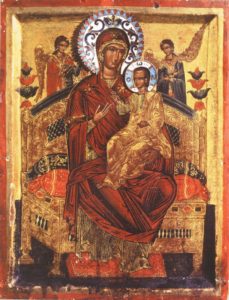
More so, in the tradition of iconography all the saints are depicted with features that resemble the icon of Christ, with the same transfigured sensory organs and heavenly appearance. They all look like they are members of the same family.

All these cases of “mistaken” identity share the same root: a prophet, a saint and a monk, all resemble the Son of God. How is it possible?

As humans we all share the image of God planted in us from our creation. We all share in fact this divine identity but, under sin, God’s face is covered in us and we become, at least outwardly, someone else.  Through sin we lose our resemblance with God and we take the appearance that the godless world around has painted on us.

The world itself has long lost its identity. It ceased to be a vehicle for man’s edification in God and was transformed in a purpose to itself, an apple of discord and enmity between people. The devil, the greatest identity thief, diabolos, the deceiver, has succeeded to sell us, starting with Adam and Eve a reality that has nothing to do with the true reality of God, but it pleases the senses and promises everything and beyond. We got hooked by his promises and now we live in this world with the illusion that it can fulfill us, we struggle everyday to achieve meaningless goals, missing completely our true purpose and destiny.

A saint on the other hand is a person that has uncovered the image of God in him and has found his place in the world by acting according to His likeness. A saint shows to the world his true identity, imitating Christ almost to the point of confusion.  “I am crucified with Christ: nevertheless I live; yet not I, but Christ liveth in me: and the life which I now live in the flesh I live by the faith of the Son of God, who loved me, and gave himself for me”. (Gal 2:20). A saint is a person that has renounced to himself and yet his identity and alterity have been fulfilled above any imagination.

This is not, however, limited only to the saints. After all we are “a chosen generation, a royal priesthood, a holy nation” (1 Pet. 2:5-9). But, paradoxically, in order for us to become who we really are, we should let Christ take over. “He must increase, but [we] must decrease.” (John 3:30) until we reach the “measure of the stature of the fullness of Christ” (Eph 4:13).  We might seem to live plentifully in this world, but it is only an illusion “For ye are dead, and your life is hid with Christ in God. When Christ, who is our life, shall appear, then shall ye also appear with him in glory.” (Col 3:3)

We are not ourselves and we are not truly living  until we are with Christ. Don’t let the world tell you otherwise; our true identity is fulfilled only by being Christians.  Christians don’t just believe differently than others, they exist in a different reality; a genuine reality in which God becomes man and man becomes god. This is God’s edition of reality, the only one true and original.

I am Christian therefore I exist!

VN:F [1.9.3_1094]
Rating: 10.0/10 (1 vote cast)
VN:F [1.9.3_1094]
Rating: 0 (from 0 votes)
  • Share/Bookmark

Tags:   · · · · 5 Comments

Passions and Humility – from the Desert Fathers

September 1st, 2010 by Fr. Vasile
Respond

Abba Poemen said of Abba John the Dwarf that he had prayed God to take his passions away from him so that he might become free from care.

He went and told an old man this: ‘I find myself in peace, without an enemy,’ he said. The old man said to him, ‘Go, beseech God to stir up warfare so that you may regain the affliction and humility that you used to have, for it is by warfare that the soul makes progress.’

So he besought God and when warfare came, he no longer prayed that it might be taken away, but said, ‘Lord, give me strength for the fight.’

VN:F [1.9.3_1094]
Rating: 0.0/10 (0 votes cast)
VN:F [1.9.3_1094]
Rating: 0 (from 0 votes)
  • Share/Bookmark

Tags:   · · · · · No Comments.

The Six Psalms and the Extinguishing of Candles

August 30th, 2010 by Fr. Vasile
Respond

At the very Beginning of the service of Orthros (Matins) the Typicon prescribes the reading   of the “Six Psalms,”  or “Hexapsalm” i.e. Psalms 3, 37, 62, 87, 102, and 142, read in that order, and combined into a single whole.

The faithful should be aware of the fact that the reading of the “Six Psalms” is one of the most important points in the service , a time when all should put aside other thoughts, stand quietly, and concentrate on these penitential prayers. The reading does not constitute a pause in Divine Services, a time during which to go for a walk outside or to talk to one’s neighbor. It is one of the holiest moments in the entire service.

The Six Psalms comprise an entire scale of experiences which illumine the Christian life of the New Testament – not merely its overall joyous mood, but also the sorrowful path to that joy.

This is why according to the rubrics of the Church, the candles in the church are to be extinguished. The falling darkness symbolizes that dead of night during which Christ, praised in the angelic song “Glory to God in the Highest,” came to earth. The semi-darkness of the church facilitates great prayerful concentration.

In his reference book The New Testament, or Explanations of the Church, the Liturgy, and of all Church Services and Furnishings, published in St. Petersburg in 1908, Archbishop Benjamin of Nizhegorod and Arzamas explains the extinguishing of candles during the Six Psalms in this way: “According to the ustav (Typicon in Greek practice) , during this reading the candles are to be extinguished. This is done so that we, able to see nothing with our eyes, might listen to the Six Psalms attentively and with fear [of God] and so that everyone standing in the dark might shed a tear and release a tender sigh. For at night, and if there is no lighted candle nearby, it is difficult for people to see one another. It is for this reason that the ustav (Typicon) directs: thus we pronounce the Six Psalms with all attentiveness and fear of God, as conversing with our invisible Christ God Himself, and praying over our sins.”

Midway through the Six Psalms, at the beginning of the 4th of the psalms, the one most filled with sorrow and extreme bitterness, the priest leaves the Altar and, standing before the Royal Doors, continues to quietly read the 12 appointed morning prayers. At that point, the priest symbolizes Christ, who, having heard the sorrow of fallen mankind, not only descended, but to the very end also shared in the suffering of which Psalm 87 speaks.

The morning prayers quietly read by the priest include prayers for the Christians standing in the church, with requests that they be forgiven their sins, that they be given true faith and sincere love, that all of their works be blessed, and that they be made worthy of the Kingdom of Heaven.

Adapted from http://www.stjohndc.org/Russian/what/e_SixPsalms.htm

See bellow a link to the Six psalms as read during Orthros:

http://www.orthodox.net/services/6psalms.html

VN:F [1.9.3_1094]
Rating: 0.0/10 (0 votes cast)
VN:F [1.9.3_1094]
Rating: 0 (from 0 votes)
  • Share/Bookmark

Tags:   · · · · · · · No Comments.

Ferdinand and the ragging bull

August 24th, 2010 by Fr. Vasile
Respond

Reading the news can be a source of inspiration and sometimes even an enlightening experience. For instance a recent news flash from Spain, about a bull that jumped 10 yards into the audience of a Spanish bullring injuring 40 people, curiously made me think that life, in a way, is like a bullfight, a “corrida de toros”.  Many times we know how dangerous or harmful some things may be to us, yet, we keep doing them or we resolve to enjoy them from the audience, with the illusion of safety.

Getting involved in something however, even from a distance, still counts as participation and inherits all the risks associated. Even if we openly avoid doing certain things that we might consider inappropriate on a superficial moral level, we still take pleasure, admittedly or not, in the decadent show of our society. We have the option to withdraw from it completely at anytime if we want to, but many times we prefer to settle with a platonic voyeuristic attitude. We do not play the “matador” but we still care for a bloody bullfight.

With this outlook we allow to pass by us many things that we should not be part of, dismissing them as items that are beyond our scope of authority and continue to observe them with a guilty, distant involvement. The Scripture however bluntly contradicts this attitude: “But I say to you, that whoever looks on a woman to lust after her has committed adultery with her already in his heart.” (Mt 5:28)

If we are serious in our rejection of sin we should also stop endorsing it, “no one cannot serve two masters.” (Mt 6:24) If you don’t like a bullfight why are you even buying a ticket in the arena? Of course you are safe in the upper stalls, but you are still on the inside, supporting, rooting for the fight and secretly hoping for blood.

Why are we then surprised when things go bad and we get hurt? The moment we chose to take on a risk we also took on the possibility of getting injured.  You don’t have to dodge a bull dressed in some crazy costume to get hurt; one can get hurt even in the stands, as we just saw.

We can’t keep playing with sin and hope for the best. The root of sin, which is the guilty thought, has to be eradicated. “O daughter of Babylon, […] happy shall he be, that takes and dashes your little ones against the stones” (Ps 136: 8). The “little ones” are the thoughts that grow in our minds, tormenting and pushing us to do or worry about things that we should not.

Any temptation starts small, allowing you to get accustomed to it, and then, when you are hooked, devours you completely. St. Nicodemus in his “Unseen Warfare” talks about this work of the devil. “The devil resembles an ant-lion since he always begins a man’s ruin by first casting him into small sins, just as an ant is small, and then, when the man becomes accustomed to such small sins, he casts him into greater. So equally the devil at first seems as weak and small as an ant, and later he appears like a powerful giant – a great lion”

Fondling with sin will not do anything but decrease our sensitivity to its great repercussions. Like in a bullfight arena, we buy first a ticket up high, playing it safe but the more we go the more courageous we get, going foolishly lower and lower, until one day a ragging bull breaks loose and hurts us, right when we were thinking that nothing bad could ever happen.

One of the major problems we face today is that the world around us is loosing the concept of sin entirely. The psychologists take all blame away from us claiming that we are conditioned by our animal instincts; we have an innate predisposition to hunt, mate, feed, dominate etc; so we are attracted by things that fulfill these deep, subconscious desires. This way of thinking accounts however only our animal side. Man has been also blessed with rationality and spirituality, which, put to good use, can control these instincts and free man to pursue his real spiritual potential.The simple fact that we can do something does not mean that we should; all things might be lawful, as the apostle says, “but not all things build up.”(1Co 10:23)

Keeping the bullfighting metaphor, man should reflect more on Ferdinand, the powerful bull which, totally turned off by the temptations of the arena, chose to retire himself in the contemplation of nature, smelling flowers and listening to birds. It was his choice to keep himself out of his excited pack of bullying peers, not because he was weak or afraid, on the contrary, because he was twice strong, in body as in will.

Control however is a faculty that doesn’t always come naturally and for most of us needs to be cultivated; learning to tame the animal in you is not as easy as it sounds. That is the reason why the Church recommends moderation, fasting, vigils and other exercises that promote self-discipline. Only following this path the seeker will learn in time to control his affects and eventually will reach a stage where all the temptations will leave him cold and unmoved.

Until this moment however, we cannot allow our guard to go down with the illusion that we are ready to face anything that comes our way, for only “he who guards his way guards his life” (Pro16:17). The options will always be there: enter the ring of the raging bulls of sin, assuming the great danger of spiritual injuries or, take a detour to avoid sin and concentrate on the things that matter and “build up”. Taking this good decision however is not just a matter of will, we cannot trust in our ability to make this choice alone at all times, but “the Lord gives strength to his people” (Ps 29:11) and in His help lies all our hope.

VN:F [1.9.3_1094]
Rating: 10.0/10 (1 vote cast)
VN:F [1.9.3_1094]
Rating: +2 (from 2 votes)
  • Share/Bookmark

Tags:   · · · · No Comments.

Pearls to the pigs and communion to dogs

July 30th, 2010 by Fr. Vasile
Respond

“Do not give what is holy to the dogs; nor cast your pearls before swine” (Mat 7:6)

When I was a kid I had a pet, a cat, and loved it dearly.  It slept with me every night and in my teenage years felt at times as my only true friend. But there was no moment during the time we had together, that I confused my pet pal with a true human friend; it remained a cat the entire time. There seems to be however a lot of confusion nowadays about animals and their role in our lives. People treat their animals as family, take them to beauty salons and spas, leave them fortunes in their wills and expect to be joined by them in heaven.

Just when I thought I heard it all I just stumbled on a recent news story where an Anglican minister went as far as giving communion to a dog.  “It was a simple church act of reaching out to a new congregation member and his pet” , the “she” minister swiftly responded to the harsh criticism surrounding her acts.

Some may be asking what is the big fuss? The evolutionists might say: as the dogs, after all, we all come from animals; we are all products of the same evolutionary process. Why denying Communion to the dogs, aren’t they also called to be saved? What is so distinctive about humans that they get all the benefits? Man is no more unique than the other animals, it is just the refined product of a distillation process that started by chance and eventually led where we are today.

As shocking as this recent story may be, the problem of equating people with animals is not new. Even St. Gregory of Nazianz was facing some of the same controversy in the 4th century: “Men say: man is a microcosmos – and they say this thinking they elevate human nature with this grandiose title, but they did not realize that actually they have honored man with the characteristics of the mosquito and the mouse”

In the quest to prove that man comes from animals, man is actually diminished to the level of a marginally more advanced living creature and nothing else, having very little to distinguish him from his “close relatives” that still dangle from one tree branch to the other. By reducing man to his animal body, man is actually abridged to matter and any spark of spirituality is completely denied to him.  Man becomes an animal with the illusion of grandeur.

But, according to Vladimir Lossky  “Human perfection does not consist in what makes him resemble with all creation, but in what sets him apart from the created order and makes him resemble his Creator”

Man was created differently than the other forms of life. God created the world by a simple “let there be…” but for man He decided to fashion him in a distinctive manner. “Let Us make man in Our image, according to Our likeness; let them have dominion over the fish of the sea, over the birds of the air, and over the cattle, over all the earth and over every creeping thing that creeps on the earth.” (Gen 1:26).

The resemblance with God that makes man different than animals is the rational origin of his soul. “Animals act on impulse (they have urges) but in man there is also “logic”; it is the Grace of God which comes and establishes itself “logically” upon the soul”, says Saint Maximus the Confessor.  Animals do not possess rationality and have no free will. They possess however, through their instincts and the spirit of life planted in them, a certain basic understanding of the world, enough for them to never fail in recognizing God and serving His will.

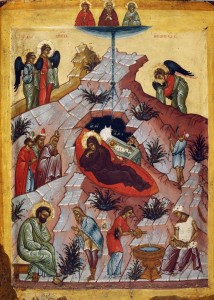
This is why Christ did not specifically minister to animals, not because they were unworthy, or because He didn’t care about them, but because the creation already knew Him and obeyed him as God. “The ox knows its owner and the donkey its master’s crib; But Israel does not know.” (Isaiah 1:3).  The icon of Nativity shows this clearly by depicting the animals as the first witnesses of the Incarnation.

On the other hand man, misusing his God given rationality and betraying his freedom of choice, in his disobedience, has forgotten Who the Master is and has fallen into sin.  Because of man and his sin the entire creation has been turned upside down and exists in the corrupted state we see today.

Man used to be at peace with all creation; Adam named all the animals and the animals recognized him and did not harm him.  (Gen 2:20) But when through sin division was brought in the world animals ceased to recognize man and the entire nature turned against man and against each other. (Gen 3:12-19, Gen 6:12)

The current condition of the world is different that what it was in paradise and different than how it will be in the Kingdom of heavens.  The cosmos can and will be redeemed and man is its intercessor: “the creation itself […] will be delivered from the bondage of corruption into the glorious liberty of the children of God.” (Rom 8:18-22).

We see glimpses of this new order and of the renewed relationship between man and animals in the lives of the saints were we encounter a raven feeding the prophet Elias in the wilderness, lions living with the desert dwellers like St. Paul of Thebes or St. Mary of Egypt, a bear befriending St. Seraphim and so many other examples. This was foretold in the prophecy of Isaiah “The wolf also shall dwell with the lamb, the leopard shall lie down with the young goat, the calf and the young lion and the fatling together; and a little child shall lead them.” (Isaiah 11:6) These saints have reached again in Christ the state that Adam had in paradise, when man was in harmony with the entire creation giving us all a pre-taste of the kingdom to come.

But this harmony does not mean that we can reduce man to the level of an animal nor we can elevate an animal to the level of man. Each have their distinct role in God’s providence and they cannot be confused. “All flesh is not the same flesh, but there is one kind of flesh of men, another flesh of animals, another of fish, and another of birds. There are also celestial bodies and terrestrial bodies; but the glory of the celestial is one, and the glory of the terrestrial is another.” (1Cor 15:39-40).

Clearly man was given a distinctive role in creation. Man is the only created being that resembles both the heavens and the earth. Man is lifted to the image of God by his rational soul while his animal body caries the weight of the clay. Thus, by the will of God man is, without overextending his already bloated hubris, the central piece of the created world and by fulfilling this divine purpose, he redeems the entire cosmos with him. “All things”, argues St. Maximos the Confessor, ” which have been created by God, in their diverse natures, are brought together in man as in a melting-pot, and form in him one unique perfection— a harmony composed of many different notes.’”

Christ came to redeem man so man can be united with God and through man the whole creation to be made part of this union. Man is called to unite creation with the Creator and the entire nature supports him in His endeavor. This is the proper order of things that man cannot change but can freely choose to respect and use for the accomplishment of his divine potential.

VN:F [1.9.3_1094]
Rating: 10.0/10 (4 votes cast)
VN:F [1.9.3_1094]
Rating: +3 (from 3 votes)
  • Share/Bookmark

Tags:   · · · · · · · · · 2 Comments

Beneath the surface – Sailing the shallow waters of the Internet

June 24th, 2010 by Fr. Vasile
Respond

When carried into the realm of the intellect, the industrial ideal of efficiency poses, a potentially mortal threat to the pastoral ideal of contemplative thought

Nicholas Carr, The shallows

There is a lot of commotion in the teaching industry around generational learning.  The premise lays in the different approaches that consecutive generations take when it comes to education. Take the baby-boomers generation, most of them like to learn in a linear fashion, read books (actually finish them) and they feel comfortable in a traditional class setting. As you move up toward the newer generations however, the situation changes. The reading pattern is not linear anymore, the learning is blended, books are abruptly loosing importance and the all mighty Internet gains more and more acceptance, sweeping in its path all that we traditionally knew about classrooms and written homework.

As an avid consumer of e-media, but not a native of the electronic age, I find myself trapped between these two worlds. I thrive daily from the efficiency of the information blazing through the Internet, but still enjoy deepening myself in the aroma of a good book on a lazy afternoon. Not that I have many of those… From this perspective I have the luxury of being able to look somewhat objective at both these worlds that are spreading apart, one going into extinction, the other one evolving into an unknown and vastly unpredictable creature.

The mirage of electronic media consists in the almost scaring efficiency to store and transmit information.  An entire library can fit now in a Kindle e-reader the size of a magazine. The incredible accessibility opening in front of millions of people renders the traditional libraries and bookstores obsolete. Who would want to spend the time to do a library search when they can access the same info from the comfort of their couch?

There is however a price to pay for this technology, as Nicholas Carr puts it in a recent article, “Media are not just passive channels of information. They supply the stuff of thought, but they also shape the process of thought[1] Today we read differently, we learn differently and dare I to say we are also starting to think think differently.

The bargaining chip of the classic intellectuals used to be knowledge, information. A doctor for instance had to go through years of medical school and hundreds of textbooks to be able to put a correct diagnosis. Today anyone can access the Internet databases and self diagnose any disease. The problem is that in most cases the information one gets is only very superficial and lacks any understanding of its deep collateral ramifications. That’s why, in most cases, although people have their information, their diagnosis is wrong. They call this cyberchondria. A real doctor on the other hand that has taken the time to deepen his understanding of each sign and symptom, reaching a higher level of understanding well beneath the surface, will be able to make the correct call.

This is what the Internet does to us: it takes away the depth of knowledge and makes us settle in the shallows. Repeated every day it becomes our way of doing everything. We become wanderers through the hyperlinks of life, not making any effort to descend bellow the shiny surface of what surrounds us. The danger in this case is not just that we might misdiagnose a simple cold, but that we might misunderstand the very essence of life.

Efficiency is critical in our lives, agree, technology is helping us get there, but we also need contemplation. Some things just need to soak with us longer so we can comprehend them.  This is particularly important in our spiritual lives. One area that is particularly affected by a superficial living is prayer. Prayer cannot be done in front of a computer screen using a search engine; prayer is not a quick afterthought while we hurry to beat the rush hour.  Prayer needs time to penetrate into our minds and from there into our hearts.  A minute or two a day in between errands is not enough.

We have contracted this contagious tendency to rush through everything, even Church services. We want them shorter and shorter. But where do we rush? To the things of the world; the same world that treats everything with superficiality and misdiagnoses the very meaning of life.

We have no time for our souls because we fail to understand the implications of this missed opportunity. We fail to understand that this life it is the only chance we get to develop a meaningful relationship with God; a relationship that takes time to develop. How can we get to know God if we spend so little time with Him, when we get only erratic and trivial information about Him? How can we love Him if we only want to meet Him online in a chat room? Some things just cannot be replaced by technology.

There are no shortcuts to heaven, only an everlasting effort to know God more every day by giving Him our full, undivided attention. We need to take the time to meditate upon our existence and make efforts to adjust it to match what is required from us Be therefore perfect, even as your Father which is in heaven is perfect.” Matthew 5:48.


[1] From Nicholas Carr, Is Google Making Us Stupid?, The Atlantic, July-August 2008

VN:F [1.9.3_1094]
Rating: 10.0/10 (4 votes cast)
VN:F [1.9.3_1094]
Rating: +2 (from 2 votes)
  • Share/Bookmark

Tags:   · · · · · No Comments.

My father? I don’t know…

June 3rd, 2010 by Fr. Vasile
Respond

I’ve recently stumbled upon two blog posts addressing the donor artificial insemination from a perspective that goes against the grain of the society trends, acknowledging a  problem that is often dismissed. Here are the links:

Orphaned at conception:

http://www.mercatornet.com/articles/view/deadbeat_donor_dads/

Who did I come from? The children of donor dads grow up:

http://www.mercatornet.com/articles/view/who_did_i_come_from_the_children_of_donor_dads_grow_up/

I also wanted to give the readers a personal Orthodox perspective, both as a priest and as a medical doctor; so here we go.

There is a great number of problems with the issue of sperm bank donors that rank from practical theology to human psychology.  I will try to put my thoughts in a coherent stream.

The “harvesting” of the sperm involves masturbation, which, from an Orthodox perspective, is wrong.  Not only the act itself is wrong, but most of the times the donors use inappropriate “arousing” materials to stimulate production, which leads to other moral problems.

The artificial insemination of a woman with a sperm from an unknown man interferes with the sacrament of marriage. This is true both for married and un-married women. A married woman will allow through insemination a third party male to interfere with the sacred union between man and wife, which technically accounts as adultery, even if the husband agrees with the procedure. The woman will carry a child that is not the fruit of the sacred union between the couple, but the product of a union, albeit non-sexual, with a third party.

A similar framework can be applied to an unmarried woman that basically will commit technical fornication by using the semen of a man to which she is not married.

Not only this interferes with marital relationship from the perspective of a woman, but also, the man commits technical fornication and/or adultery by inseminating one or several women out of wedlock.

Another situation that is rapidly increasing in frequency is lesbian couples. Here the situation of an unmarried woman is further complicated by the sexual preference of the mother(s) that, according to the canon law of the Church, is considered “against nature”.

The confidentiality involving to the identity of the donors and the lack of disclosure of their birth accounts to the siblings by their (adopted) parents, corroborated with the relative high number  and the lack of control of such artificial inseminations brings also the possibility of incestuous relationships. What if a person conceived using this technique encounters another one, similarly fashioned, and they happen to be, without knowing it, brother and sister, sharing the same donor as a father? We know that from a canon law perspective weddings are not permitted between blood relatives, up to a certain degree.

The consanguinity that may occur in such very probable incestuous relationships may also lead to medical problems since the offspring of such relationship will be more prone to certain genetic disorders.

The greatest damage however is done at the level of the family. As Christians our life is centered on Christ and His Church. We apply all the Christian teachings in the safe shelter of our homes. Our homes become, as St. John Chrysostom observed “small churches”. We have the duty to preserve our homes as such. By using techniques like the donor artificial insemination we disturb the spiritual balance of our homes and we expose ourselves to unjustified spiritual dangers.

After all, as the Fathers say the purpose of marriage is neither mutual sexual satisfaction, nor having children, but becoming one with the purpose of salvation. The goal of our lives does not change with marriage, we still seek theosis, but now together and not as individuals anymore. Children are a blessing and a beautiful fruit of a healthy marriage between a man and a woman.; they are not a must for salvation.  We can be saved even as an infertile couple. I know this is difficult to accept, but by forcing God’s hand to comply with our egotistic wishes, through means above reason and decency, we transform the so wanted children in idols. Children conceived like this are not the fruit of love, but the product of an obsession with parenthood.

We don’t have to forget that once we have exhausted all the reasonable and blessed means for conception there are also other alternatives to parenting: adoption or becoming a God parent are blessed avenues that infertile couples can follow.

VN:F [1.9.3_1094]
Rating: 7.6/10 (5 votes cast)
VN:F [1.9.3_1094]
Rating: +3 (from 3 votes)
  • Share/Bookmark

Tags:   · · · · · · · · · No Comments.

Through their eyes – On the Holy Icons

May 27th, 2010 by Fr. Vasile
Respond

Then a second time they called the man who was blind and said to him, Give glory to God. We know that this man is a sinner. He answered and said, “Whether He is a sinner, I do not know; one thing I do know, that being blind, now I see.”

(Joh 9:24-25)

I would like to begin with a question: What is Orthodoxy? You may give me an answer related to the purity of the dogmas, or the correct worship or something of the sort. You would be very right thinking this way. I personally find appealing a definition that I’ve found in an article of a contemporary theologian, deacon Andrey Kuraev. He says that Orthodoxy is Christ seen through the eyes of the Apostles.

This definition needs a bit of an explanation. In life different people can look at the same person or occurrence and understand it differently. Likewise, Christ’s messianic activity was seen and understood differently by his contemporaries. Take for instance the episode when Pontius Pilate interviews Jesus in the Praetorium. Pilate saw in Jesus a religious fanatic, a man living in a world of dreams that cannot accurately perceive the harsh reality in which He will most probably be condemned to a horrible death. In the same room, the Jews leaders saw Christ as a threat to their status quo, a great challenge to their self-righteous way of life. The crowd outside, incited by their leaders, saw Him as someone of no value, or at least of less value than a common criminal, like Barabbas. The only people that indeed saw in Christ Who He really was, the Christ, the Messiah, the Son of God Who came to save the world from its eminent perdition, where the Holy Apostles.

Even the Apostles did not understood this right from the beginning and they did not truly believe everything until the Resurrection and Pentecost. But after these events their vision was opened and with their transfigured sensed they had a clear vision that was captured in the Holy Scriptures and in the entire Holy Tradition of the Church. This is Orthodoxy.

Of course you may ask yourselves now what this long introduction has to do with icons? In my opinion has everything to do with the icons because in a similar fashion we can say that the icons are a representation of the reality of God as it is seen through the transfigured eyes of the Church.

I say this because the authenticity of the reality we see around us is confined to the limitations of our human senses. We can only see, smell, taste what is material, what has the same composition as we do. The sight, the hearing, the smell, the taste and touch are nothing but chemical, mechanical or electrical stimulations interpreted by our brain. They are by definition physical, material. Based on this one can say that the senses, on which we base most of our understanding of the world are, in a way, crippling us in what it concerns the spiritual perception of reality.

Let me explain this further. [Read more →]

VN:F [1.9.3_1094]
Rating: 0.0/10 (0 votes cast)
VN:F [1.9.3_1094]
Rating: +2 (from 2 votes)
  • Share/Bookmark

Tags:   · · · · · No Comments.

Curing the new depression era

April 23rd, 2010 by Fr. Vasile
Respond

For what has man from all his labor, and from the troubling of his heart, in which he has labored under the sun? For all his days are sorrows, and his labor sadness; yea, his heart does not take rest in the night.

(Ecc 2:22-23)

North European airports are still fighting with the giant cloud of ashes following the eruption of the unpronounceable Eyjafjallajökull volcano in Iceland. The aviation havoc reaches the entire world as the global flight network goes unbalanced with several of its major airports closed. But this is not the first time it happened. Iceland was the theater of another devastating eruption in 1783 when the Laki volcano decided to blow throwing into famine a quarter of the island population. At that time many European countries were also affected: a toxic cloud flew over Poland, England experienced what they called the “sand summer” and France lost many of his crops and the famine that occurred pushed them a bit further toward the revolution of 1789.

Similar events, however, take place all the time: a tornado in Oklahoma, a tsunami in Thailand, an earthquake in Haiti or Chile, you can almost pick the disaster of the day. Calamities do happen and without warning, despite the sophisticated prophecies of the scientists. On personal level catastrophes of lower overall magnitude, but nevertheless inducing similar amounts of pain, like disease, loss of a relative, getting laid off and so on, keep coming our way when we expect them the least.

In moments like this we feel small, insignificant and powerless. Anger, frustration, depression take over many people trying to make any sense of it all. Ideally, we would all like to live in a world where we can predict everything, where we can evacuate cities in time, where we can save the lives of our loved ones, keep our jobs forever and so on. But such a world does not exist. We live in a reality that is beyond our capabilities of control, governed by rules that we cannot change, acting in ways that we cannot predict. So what can we do to protect ourselves from all this?

The short answer is: nothing. We cannot stop the rain from falling. But what we can actually do is cure ourselves from the fear of it all. The fear that overcomes us has its roots in our insatiable need for control, in our desire to be independent, to be the masters of our own world. But this is actually what brought us in the position we are now in the first place. Here is what the serpent told Adam while tempting them in the Garden of Eden: “God knows that in the day you eat of it, then your eyes shall be opened, and you shall be as God, knowing good and evil.” This was enough to convince Eve: “And when the woman saw that the tree was good for food, and that it was pleasing to the eyes, and a tree to be desired to make wise, she took of its fruit, and ate. She also gave to her husband with her, and he ate. “(Gen 3:5-6)

Today is no different. We all want to be wise, to get the next magic pill that will allow us, without effort, to understand all that surrounds us and be like God, having control overall. In this insatiable desire for power we fail to realize our place in the great scheme of thing: we are the creation and he is the Creator. We cannot reverse this order, on the contrary the more we struggle with it the more we suffer. The temporality and corruptibility of the world is the consequence of our departure from God and our approaching to materiality. Being away from God we care about all the material things because we are afraid that this existence is the only reality there is and we try to make it as comfortable and pleasurable as possible. But the more things we have and the better we live the more we are afraid we are going to lose them. It is a vicious circle that’s dragging us down to the darkest of places.

But here is what Jesus Christ says in the Gospel of Luke: “Whoever will save his life shall lose it, but whoever will lose his life for My sake, he shall save it. “(Luk 9:24). This is the solution to our problem, in fact to all our problems. We can do nothing for the body and for this short life. We cannot save it. Despite all the modern medicine and all the science we will still die one day, we will still be mortals and we’ll go back into the earth from which we were taken. Bodies can’t be saved, but our souls can. The true purpose of life is to make this happen, to ensure that our souls are saved; that in the end, at the second coming of Christ, we will gain the Kingdom, even though we lost the world.

To cure ourselves from the fear of it all we have to stop living entirely for the body and pay more attention to the soul. Do not fear those who kill the body but cannot kill the soul; rather fear him who can destroy both soul and body in hell. (Mat 10:28). This is the only fear we should keep: that of losing our salvation, of getting lost into nonsensical minutia and miss the entrance in the kingdom like the five foolish virgins from the parable. (Mat 25:1)

Our lack of control is forcing us to keep a watchful attitude. Therefore watch, for you do not know either the day or the hour in which the Son of Man comes. (Mat 25:13) But this is not a fearful expectation but a joyful one, looking forward to meet the bridegroom: “Rejoice evermore. Pray without ceasing. In everything give thanks, for this is the will of God in Christ Jesus concerning you.” (1Th 5:16-18)

The only chance we have of curing ourselves from this chronic anxiety is to stop living in the world and start living in the Kingdom today. Lose our earthly citizenship to gain a passport in heavens where “there is neither Greek nor Jew, circumcision and uncircumcision, foreigner, Scythian, slave or freeman, but Christ is all things in all”. (Col 3:11)

Learn to accept God’s will with joy, in god or bad, in pain or bliss.  His will should be done because He knows always better, what is truly good for us; in Him we should put our trust, not in man. This is our true freedom, “In God I have put my trust; I will not be afraid of what man can do to me.”(Psa 56:11)

Salvation is only with the Lord. He came on the earth to cure it of sin, but He did not promise a release from suffering, on the contrary He Himself has suffered and unjustly so. The world is already damaged and cannot be quick-fixed anymore, it has to be refashioned from the ground. He came to show us how it is done, how life should be lived, how pain, suffering and death can be overcome and lead to something new, something better, something eternal. Do not fear what you are about to suffer. […] Be faithful until death, and I will give you the crown of life. (Rev 2:10). We cannot escape death, it’s true, but we can always choose to be resurrected with Christ.

Christ is risen! He is risen indeed!

Here is a short prayer from the elders from the Optina Monastery that can help us get one step further everyday to the understanding of the inevitable things in life and acceptance of God’s will in all things.

Grant unto me, O Lord, that with peace of mind I may face all that this new day is to bring. Grant unto me to dedicate myself completely to Your Holy Will.  In every hour of this day, instruct and support me in all things. Whatsoever tidings I may receive during the day, teach me to accept tranquilly, in the firm conviction that all eventualities fulfill Your Holy Will. Govern my thoughts and feelings in all I do and say. When things unforeseen occur, let me not forget that all comes down from You. Teach me to behave sincerely and rationally toward every member of my family, that I may bring confusion and sorrow to none. Bestow upon me, my Lord, strength to endure the fatigue of the day, and to bear my part in all its passing events. Guide my will and teach me to pray, to believe, to hope, to suffer, to forgive, and to love.Amen.

VN:F [1.9.3_1094]
Rating: 10.0/10 (4 votes cast)
VN:F [1.9.3_1094]
Rating: +2 (from 2 votes)
  • Share/Bookmark

Tags:   · · · · · 2 Comments

Witnessing the Light or What happens after Resurrection?

April 7th, 2010 by Fr. Vasile
Respond

O Jerusalem, be exultant, dance and leap for joy, for you have witnessed Christ the King coming forth as a Bridegroom from the sepulcher

(Stichera of Pascha)

It is magnificent to participate in the Church services on Pascha night, to be part of the joyful festival of light that the Resurrection of Christ brings on earth. The only sad part is that we start with many and end up with a few. Many people come, they receive the light, listen to the Gospel and hasten to go home thinking they have fulfilled their duty as Christians. But just witnessing the Resurrection is not enough, and is not the goal, what comes after is equally important. The miracle of Christ’s Resurrection is, or better said, should be, a life changing event; should be the sparkle that would ignite your whole being in fire, should be the ferment that will initiate your complete refashioning, should be the impulse that will keep you going until the very end on the right path to salvation.

But who believes in miracles today anyway? The Words of Abraham, addressing the unmerciful rich man from the parable of poor Lazarus, make more sense now than ever: “If they do not hear Moses and the Prophets, they will not be persuaded, even though one rose from the dead.” (Luk 16:31). It is true: even after Christ, God Himself, has risen from the dead, we still want more proof. We still want God to prove, personally, to us, that He exists and all about Him is true. However, no matter how much proof we get, as stubborn children, we don’t want to understand and we keep fabricating explanation after explanation to every piece of evidence God puts in front of us.

Starting with the prophets of old and the history of the people of Israel, the Mother of God and the Apostles, continuing with the victorious Martyrs, the Fathers of the Church and all the saints, the miracle working icons, the uncorrupted relics of the saints, and we can go on and on, God surrounded us by “a cloud of witnesses” (Heb 12:1). We cannot continue to ignore all this testimonials that point unmistakably to the existence of a most powerful God Who loves mankind. We just have to open the synaxaries, read the lives of the saints and will see God at work: healing the sick, changing sinners into saints, doing justice to the wronged, giving hope to the hopeless and joy to the mourning. We have to be blind to overlook what should in fact overwhelm us.

What we see in the lives of the saints is nothing but the effect that Resurrection had on them. They did not limit themselves to be observers, to be spectators, to watch the “show” of Resurrection; they decided to play an active role in it. Each one of them declared: I have been crucified with Christ, and I live; yet no longer I, but Christ lives in me. And that life I now live in the flesh, I live by faith toward the Son of God, who loved me and gave Himself on my behalf. (Gal 2:20)

Being witnesses to the resurrection of Christ should prompt us to do something different, to loose the old habits that take us away from Him and replace them with new ones that will unite us with Him forever. If we don’t know Him, now is the time to be introduced, if we don’t come to church, now is the time to enter, if we don’t pray, now is the time to ask His mercy, if we don’t love, now is the time to partake in His unmatched love for us.

 Don’t let this opportunity slip away by rushing home too soon. Christ is here and extends a hand to you, a hand that can take you out of the Hades of a superficial existence. Take it and be lifted up into life; take it and let Christ show Himself to you, personally, melting away all the doubts with His presence and replacing them with redeeming faith; take it and let this day be the first of your new life in Him.

 Christ is risen! He is risen indeed!

VN:F [1.9.3_1094]
Rating: 10.0/10 (3 votes cast)
VN:F [1.9.3_1094]
Rating: 0 (from 0 votes)
  • Share/Bookmark

Tags:   · · · · · No Comments.