Gladsome Light Dialogues – An Orthodox Blog

A journey through our Orthodox faith as we live it every day

Gladsome Light Dialogues – An Orthodox Blog header image 2

Setting a good beginning

December 31st, 2011 by Fr. Vasile
Respond

As the New Year is just around the corner, for many people also comes the time for setting their New Year resolutions. This year I will reach my ideal weight, this year I’ll take better care of my health, this year I’ll finish the college that I always wanted and so on. The first weeks of the year the gyms are full of enthusiastic first time athletes, the grocery stores have record sales for diet foods and the pharmacies sell years worth of nicotine patches.  But the statistics show however that only 8% of people are successful in achieving their resolutions. So come February the gym crowds vanish, the excitement fades away and life goes back to its usual unforgiving pace.

Why do so many people fail in their New Year resolutions? One research shows that most of the people that fail their goals focus too much on the downside of not reaching their targets and rely solely on will power to achieve them. On the other hand the same research shows that people who break their goals into smaller ones and integrate themselves in a support network are more likely to be successful.

Spiritually a similar situation occurs especially within the Sacrament of Confession. Most of the people that come to take the burden of sin of their chests also want to get rid of its weight forever, so they come to Confession with the strong will to begin a renewed life in Christ. I will start fasting, I’ll do my daily prayers, I’ll help the poor, I won’t sin anymore. But come next Lenten season most of them arrive confessing the same, over and over again.

The Fathers call this wish to start anew “setting a good beginning”. Indeed that’s what Confession is all about, we come to clean our sinful self so by the power of the Holy Spirit we are renewed and be given the great opportunity to start again with a pure soul. This is very similar with Baptism, where the old man dies as he is immersed in the water while a new man emerges victorious in Christ upon the exit.  The difference between Baptism and Confession is that Confession can be repeated every time we fail. God knows that the “spirit indeed is willing, but the flesh is weak” (Mat 26:41).

As with the New Year Resolutions we have to break a vicious circle in order to be successful in our spiritual endeavors. The first thing one should be aware of is not to set goals to high. Elder Cleopas  from the Sihastria Monastery  used to say that ”the forest guardian is not afraid of those who come once a year to cut a big tree, but he fears those that come every day and take only few branches that added make much more”. In a similar fashion, in our spiritual life, we don’t get anywhere by setting goals that we can’t achieve, or we can achieve isolated  with great efforts:  like strict fasting the entire Great Lent, while we never fasted before, or reading a Psalter a day, while we can’t pray for 5 minutes at a time and so on. Our spiritual goals should be small but consistent.

Progress in our spiritual life should comes out of this consistency of doing something every day and adding a little at the time. “An elder was asked by one of his disciples ‘Father teach me how to pray’. The father answered: ‘Pray and prayer will teach you how to pray!’” Heroic things never work because they either lead to failure or pride that eventually leads also to failure.

Another important aspect of our spiritual struggle is to never isolate ourselves from the community of the Church. The Church is our main support system in our ascetic endeavors. Receiving the Sacraments, especially Confession and Holy Communion, brings us all close together with God and through Him with our brothers and sisters. We are all together in this great work of redemption and we can greatly help each other in achieving our personal spiritual goals that summed take us all towards the salvation of the entire world.

The most important however is to never let ourselves be discouraged by failure. “A young monk said to Abba Sisoes: “Abba, what should I do? I fell.” The elder answered: “Get up!” The monk said: “I got up and I fell again!” The elder replied: “Get up again!” But the young monk asked: “For how long should I get up when I fall?” “Until your death,” answered Abba Sisoes. “For a man heads to his judgment either fallen or getting back up again.”

Persevering and continuing to fight for virtue is the way of the Christian. There is no escape from the pain of this cycle of failure and redemption. But we should learn to endure it with hope knowing that, even though we are not perfect, even though we have failed Christ, we remain Christians because we continue to valiantly fight with all we have left in us until the very end.

“When Abba Sisoes lay upon his deathbed, the disciples surrounding the Elder saw that his face shone like the sun. They asked the dying man what he saw. Abba Sisoes replied that he saw St Anthony, the prophets, and the apostles. His face increased in brightness, and he spoke with someone. The monks asked, “With whom are you speaking, Father?” He said that angels had come for his soul, and he was entreating them to give him a little more time for repentance. The monks said, “You have no need for repentance, Father” St Sisoes said with great humility, “I do not think that I have even begun to repent.”

After these words the face of the holy abba shone so brightly that the brethren were not able to look upon him. St Sisoes told them that he saw the Lord Himself. Then there was a flash like lightning, and a fragrant odor, and Abba Sisoes departed to the Heavenly Kingdom.”

The glorious ending of Abba Sisoes is not an isolated occurrence, but many that have allowed Christ to grow in them have followed this example of dedicating their entire lives to perfection in Christ, never content of their results, always looking for new ways to be more like Him.

Like the river Jordan turned back its course towards its springs, when Christ entered in its waters, so the person that has Christ entering in his heart turns the course of his life towards the source of his life that is found only in God. This is what “setting a good beginning” truly means, to always look towards God and direct one’s  life towards him, step by step, step by step.

May this New coming Year be for You and Your families full of peace, joy and hope in the mercy of our Lord! Amen.


VN:F [1.9.13_1145]
Rating: 5.0/5 (1 vote cast)
VN:F [1.9.13_1145]
Rating: +2 (from 2 votes)

Tags:   · · · · · · · · · No Comments.

Parking in the priest’s spot or what do we do when no one is watching?

December 1st, 2011 by Fr. Vasile
Respond


Most parishes in the United States have a designated parking spot for their priest, usually somewhere close to the Church’s entrance.  The reasons are understandably practical. In reality this space proves to be an apple of discord and a stepping-stone for many that dream to park just inches away from the building. Nobody dares however to park there if they know the priest might be stopping by. But as soon as the danger of being caught ebbs away there will always be someone that will take up that spot.

You might already be asking yourself at this point, is it I that Father is complaining about? Guilty or not, this article is not about my frustration of finding out that my spot was taken. I don’t care… Continue reading

Tags:   · · · · No Comments.

The implications of music in the liturgical life of the Church

November 10th, 2011 by Fr. Vasile
Respond

I will praise the LORD all my life; I will sing praise to my God as long as I live.(Ps 146:2)

Like with any of the other arts employed by the Orthodox Church in its worship, the music does not serve a purpose in itself. Once used in Church the music drops its role as simply embellishing the services and it is elevated to convey, on a deeper level, the meaning of the prayer contained in the hymns of the church and make them resonate with our souls through its melodies. Great saints of the Church, like John Damascene, Ephraim the Syrian, Roman the Melodios, Andrew of Crete, Joseph the Hymnographer, Kosmas the Poet, John Koukouzelis and many others, have carefully matched the meter of… Continue reading

Tags:   · · · · · · · · · · · · · 6 Comments

The Freedom of Morality and the Imorality of Freedom

November 4th, 2011 by Fr. Vasile
Respond

The recent overthrowing of the authoritarian governments from the Middle East countries has brought up again the importance of freedom as an essential human value. The notion of freedom however is not as easy to define as one would think. In general we understand that freedom means the capacity to act without any outside restraint. As J. Rufus Fears, professor of Classics and chair in History of Liberty at the University of Oklahoma, asserts, this concept can be applied to a nation for example that is free from any outside domination, can be applied to a political system, meaning that one can elect its own choice of government, but most importantly can be applied to the individual that is… Continue reading

Tags:   · · · · · · · · · · No Comments.

My Big Fat Greek Festival

October 3rd, 2011 by Fr. Vasile
Respond

Reposting this older article as we get closer to the 30th Greek Festival in Eules, October 7,8,9 2011.

Festival page here

We just closed the doors of another Greek Festival at Saint John’s. We are all happy, but tired, and some may think, and we cannot blame them, why we do this every year? A short answer would be: we need the money! And it is a good answer, but maybe we could find other ways to raise the needed funds. Still I think, even though we might manage to get there, we should continue doing the festival. And I will present my argument for it.

In the present times the… Continue reading

Tags:   · · · · 4 Comments

Drought and redemption – The Lessons of Global Warming

September 30th, 2011 by Fr. Vasile
Respond


“And the LORD shall guide thee continually, and satisfy thy soul in drought, and make fat thy bones: and thou shalt be like a watered garden, and like a spring of water, whose waters fail not.” (Isaiah 58:11)

October 2010 to July 2011 was the driest of any 10-month period on record for Texas. Scorching heat, wildfires, crops destroyed, cattle herds relocated seem to be the new norm for the Lone Star state. But we are not the only ones suffering this, Asia, Africa are also experiencing similar weather patterns, bringing millions to the brink of starvation.

Who is to blame? Some say the global warming, others argue that is a natural variation of… Continue reading

Tags:   · · · · · · · · · · · · · No Comments.

Spiritual Ground Zero

September 14th, 2011 by Fr. Vasile
Respond

Many people would agree that the September 11 terrorist attacks changed not only New York, not only America, but most of the world in many ways. We are involved in a 10 years war in which countless people have lost their lives, soldiers and civilians together; our travel experience hase deteriorated tremendously; our watchfulness level has been raised to paranoid heights; even some people report that church attendance, at least in the United States, might have slightly increased as a result.

The main reason for all this change is that the horrible events in New York shook us all to the core and inflicted a wound that cannot be healed without a visible scar. From an emotional point of… Continue reading

Tags:   · · · · · · · · · · · No Comments.

Looking Death in the Face or The Aesthetics of Dying

August 31st, 2011 by Fr. Vasile
Respond

“Death is swallowed up in victory. O death, where is your sting? O grave, where is your victory?” (1Cor 15:54-55)

As a parish priest one has the privilege to face all aspects of human life from birth until the final departure. In the eyes of a priest, humanity is exposed in its most glorious and most deplorable experiences. Among them one of the most challenging is death. Even writing about it is a difficult task because it is a very unpopular subject.  Nobody wants to die and even more so, nobody wants to talk about it, is a taboo, a place where you just don’t want to go… Continue reading

Tags:   · · · · · · · · · · 1 Comment

Paraklesis to the Mother of God Pantanassa, the Healer of cancer

August 13th, 2011 by Fr. Vasile
Respond

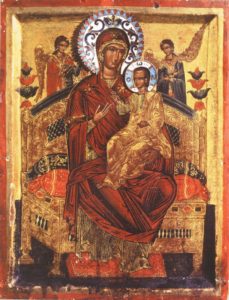
The holy and miracle-working icon of the Virgin Mary was brought to the Vatopedi monastery by the blessed elder Joseph from Nea Skete. The Monastery of Vatopedi is one of twenty monasteries on the Mount Athos peninsula (Greece) and is located on the northeastern side of the peninsula. It operates as a coenobitic monastery(a communal monastic community). As of 1999, it is inhabited by 80 monks and is second in hierarchical rank among the monasteries of the mountain.

The first record of the icon’s miraculous powers is from the witness of Elder Joseph. One day a young man from Cyprus went to visit and entered into the church. At that point, the elder witnessed a glowing light radiating from the face of the Theotokos and an invisible power pushed the young man down to the ground. When the young man had recovered from his fall, he began to repent and weep and confessed that he did not believe and was a participant in the black arts. He changed his life and became an Orthodox Christian.

This icon is also known for working many miracles, especially healing people with cancer. There are many recent records of people who have been healed from cancer after participating in the Supplicatory Canon to the Pantanassa at the monastery.

Text from http://russian-crafts.com/russian-saints-icons/pantanassa.html

The following text was translated and set to meter by Fr. Vasile Tudora. Some of the text (especially the heirmoi of each ode) is  based on the translation of the Small Paraklesis to the Most Holy Theotokos from http://goarch.org/chapel/liturgical_texts/paraklesis. This has been done to ensure consistency with the current chanting practice in the Greek Orthodox Churches in America.

Pantanassa Paraklesis Booklet for parish usage

Tags:   · · · · · · · · · · · · No Comments.

Who’s afraid of the Most Holy Virgin Mary?

August 3rd, 2011 by Fr. Vasile
Respond

The veneration of the Virgin Mary has long been point of contention among Christians. Although it may be difficult to delineate a uniform position among the plethora of Protestant denominations, it is generally recognized that most of the Reformed Churches have no particular place of honor for the Virgin Mary in their theology or worship. Most believe that her role was fulfilled at giving physical birth to the human Jesus Christ and from there on she is nothing but a regular woman that went on with her life, having other children and never to be heard of again. On the other hand the Roman Catholic and the Eastern Orthodox, although may differ in some theological aspects, hold the Virgin Mary… Continue reading

Tags:   · · · · · · · · · · · No Comments.